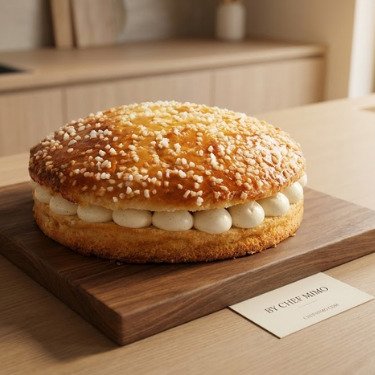
✨ The Spirit of the South of France: A pillow-soft brioche infused with orange blossom, filled with a light diplomat cream and topped with crunchy pearl sugar.
“La Tropézienne” is not just a cake; it is a legend born in the 1950s in the coastal village of Saint-Tropez. Legend has it that the famous actress Brigitte Bardot named it herself while filming there. This dessert is deceptively simple; it consists of a tender brioche disc, rich with the scent of butter and orange blossom water, sliced in half to embrace a unique creamy filling. This filling is a luxurious hybrid between “Crème Pâtissière” (Pastry Cream) and airy whipped cream, often referred to as “Diplomat Cream” or “Princess Cream.”
The secret to a perfect Tropézienne lies in the contrasts: the airy texture of the brioche against the cool, rich cream, and the smoothness of the filling against the crunch of the coarse sugar pearls on top. It is the quintessential summer dessert, perfect for tea parties or as a sophisticated finish to a family meal. With this precise recipe, you will be able to bring the breeze of the French Riviera directly into your kitchen, ensuring a successful brioche and a stable cream that won’t collapse when served.
🥣 INGREDIENTS
Here is the table of ingredients (for a 24 cm diameter tart):
| Component (Section) | Quantity | Notes |
| 🍞 For the Brioche Dough | ||
| Flour (T45 or Strong Bread Flour) | 300g | High gluten is best |
| Whole Eggs | 2 | Very cold |
| Milk | 25g | Cold |
| Orange Blossom Water | 25g | |
| Heavy Cream (Liquid) | 45g | Cold |
| Sugar | 40g | |
| Salt | 6g | |
| Fresh Yeast | 11g | (Or 4g dry yeast) |
| Softened Butter | 100g | Room temp |
| For the Glaze (Dorure) | ||
| 1 Egg Yolk + 1 tbsp Cream | For brushing | |
| Pearl Sugar (Nib Sugar) | As needed | For topping |
| 🍦 For the Orange Blossom Vanilla Cream | ||
| Whole Milk | 385g | |
| Orange Blossom Water | 30g | |
| Sugar | 75g | |
| Egg Yolks | 2 | |
| Cornstarch (Maïzena) | 30g | |
| Gelatin | 4g | (Approx. 2 sheets) |
| Vanilla Bean (Madagascar) | 1 bean | |
| Cold Butter | 60g | Diced |
| Heavy Cream (for whipping) | 200g | Very cold |
| Mascarpone Cheese | 25g | Very cold |
| 💦 For the Syrup | ||
| Orange Blossom Water | 20g | |
| Water | 100g | |
| Sugar | 70g | |
| Empty Vanilla Pod | (From the cream) |
👩🍳 PREPARATION STEPS (Step-by-Step)
The steps are presented in the exact sequential order as the original source to ensure the text matches your images.
Step 1: Kneading & First Rise (Pétrissage et Pointage)
-
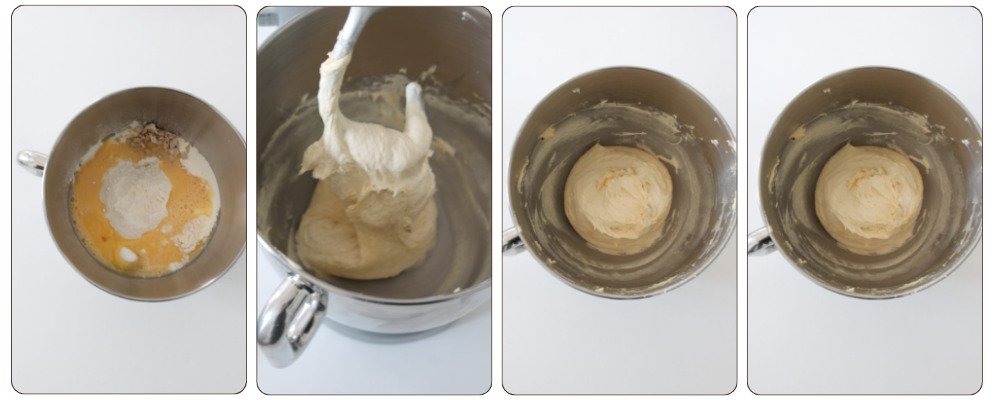
In the bowl of your stand mixer fitted with the dough hook, place the flour, sugar, salt, eggs, milk, orange blossom water, cream, and yeast. (Be careful not to let the yeast touch the salt directly).
-
Knead at Speed 1 for 5 minutes, then increase to medium speed for 12 minutes. The dough should have an elastic consistency and be slightly sticky.
-
Still at medium speed, add the softened butter little by little. Knead for another 5 minutes until the dough pulls away from the sides of the bowl.
-
Cover the dough with plastic wrap and let it rest (proof) for 30 minutes at room temperature.
Step 2: Rest & Shaping (Repos et Façonnage)
-
Degas the dough (punch it down) and fold it over itself.
-
Place the dough in a lightly floured bowl and cover with plastic wrap.
-
Place the dough in the fridge for at least 2 hours (overnight is ideal) to chill and firm up for shaping.
[DURING THE REST TIME] Prepare the Cream Base
-
Soak the gelatin leaves in a large bowl of cold water.
-
In a saucepan, bring the milk, orange blossom water, half of the sugar, and the vanilla seeds to a boil (save the empty pod for the syrup). Remove from heat immediately.
-
In a bowl, whisk the egg yolks with the remaining sugar, then add the cornstarch and mix well.
-
Pour half of the hot milk over the egg mixture and stir. Pour everything back into the saucepan with the remaining milk.
-
Bring the cream to a boil over medium heat for 1 to 2 minutes while stirring constantly with a whisk (do not exceed 84°C). It should thicken.
-
Remove from heat, add the squeezed gelatin and the diced cold butter. Mix well to homogenize.
-
Pour into a shallow dish, cover with plastic wrap touching the surface (contact wrap), and refrigerate until assembly.
Step 3: The Syrup
-
In a saucepan, bring the water, orange blossom water, sugar, and the empty vanilla pod to a boil.
-
Set aside for assembly.
Step 4: Proofing & Baking (Pousse et Cuisson)
-
 Take the dough out of the fridge.
 -
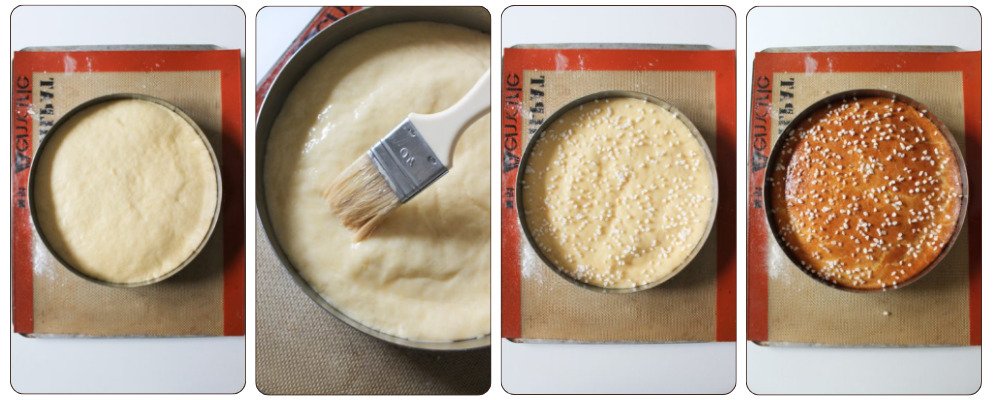
On a baking sheet lined with parchment paper, spread the dough slightly by pressing with your hands inside a 24 cm ring.
-
Place the brioche in a warm room or inside your turned-off oven with a bowl of hot water at the bottom to create a steam chamber. The temperature should be around 28°C (do not exceed 29°C).
-
Let it proof for 2 hours; it must double in volume.
-
Brush the brioche with the egg wash and sprinkle generously with pearl sugar.
-
Bake at 170°C (340°F) for 20 minutes (time may vary depending on your oven).
-
Let the brioche cool completely on a wire rack.
Step 5: Assembly (Montage)
-
Cut the brioche in half lengthwise (horizontally).
-
Soak both halves generously with the syrup.
-
Whip the cold heavy cream with the mascarpone until you get a firm Chantilly.
-
Delicately fold this whipped cream into your chilled “Vanilla Orange Blossom Cream base” (from Step 2).
-
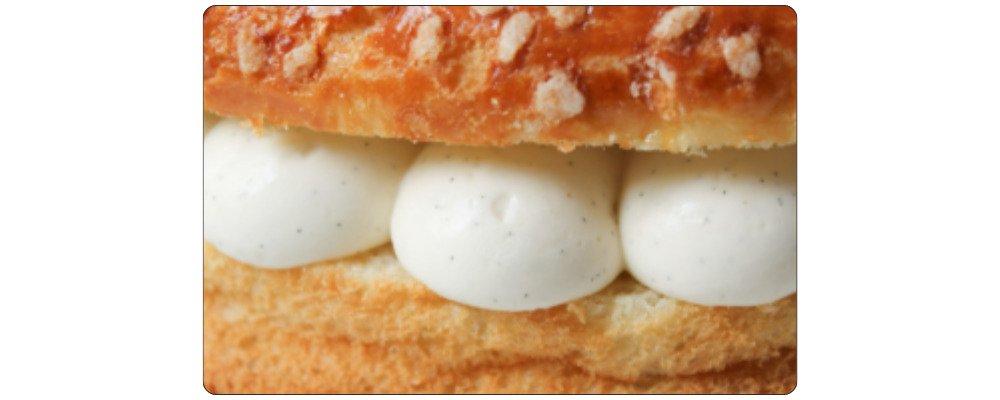
Place the final cream in a piping bag fitted with a 16mm smooth nozzle.
-
Pipe beautiful balls of cream onto the bottom half of the brioche and close with the top cap.
-
Enjoy your treat!
Chef’s Guide & Conclusion
You have just mastered one of the most beloved French holiday desserts. The Tropézienne might look intimidating because it involves yeast dough and pastry cream, but by breaking it down, you are simply making a great burger bun (a sweet one!) and a stable filling. Here are the professional secrets to ensure your Tropézienne is worthy of a St. Tropez bakery.
The Science of Brioche:
-
Temperature is Key: Notice how the recipe calls for cold eggs and cold milk? This is crucial. Kneading generates heat (friction). If your ingredients are warm, the butter will melt into the dough rather than emulsifying, making the brioche greasy and heavy. We want the butter to remain stable until it hits the oven.
-
The Windowpane Test: You know your kneading is done when you can stretch a small piece of dough between your fingers until it is translucent without tearing. This means the gluten network is strong enough to trap the air bubbles.
The “Diplomat” Cream:
The filling used here is technically a Crème Diplomate. It combines the flavor and richness of pastry cream with the lightness of whipped cream.
-
Why Mascarpone? Adding mascarpone to the whipping cream increases the fat content. This stabilizes the whipped cream so it doesn’t weep or deflate when mixed with the heavier pastry cream base.
-
Why Gelatin? Gelatin is the structural engineer here. It ensures that when you slice the cake, the cream stays put and doesn’t squish out the sides.
The Syrup Factor:
Do not skip the syrup! Brioche is naturally bread-like. To transform it into a dessert that melts in your mouth, the syrup provides moisture and an extra punch of orange blossom aroma that defines the authentic Tropézienne flavor profile.
Storage:
Unlike mousse cakes, this dessert is best eaten fresh. The brioche tends to harden in the fridge. If you must store it, keep it in an airtight container in the fridge for up to 24 hours. Take it out 20 minutes before serving to let the brioche soften slightly while the cream remains cool.
You are now equipped with a classic recipe that bridges the gap between bakery and patisserie. Bon appétit!
(Would you like a shopping list organized by supermarket aisle for this recipe?)